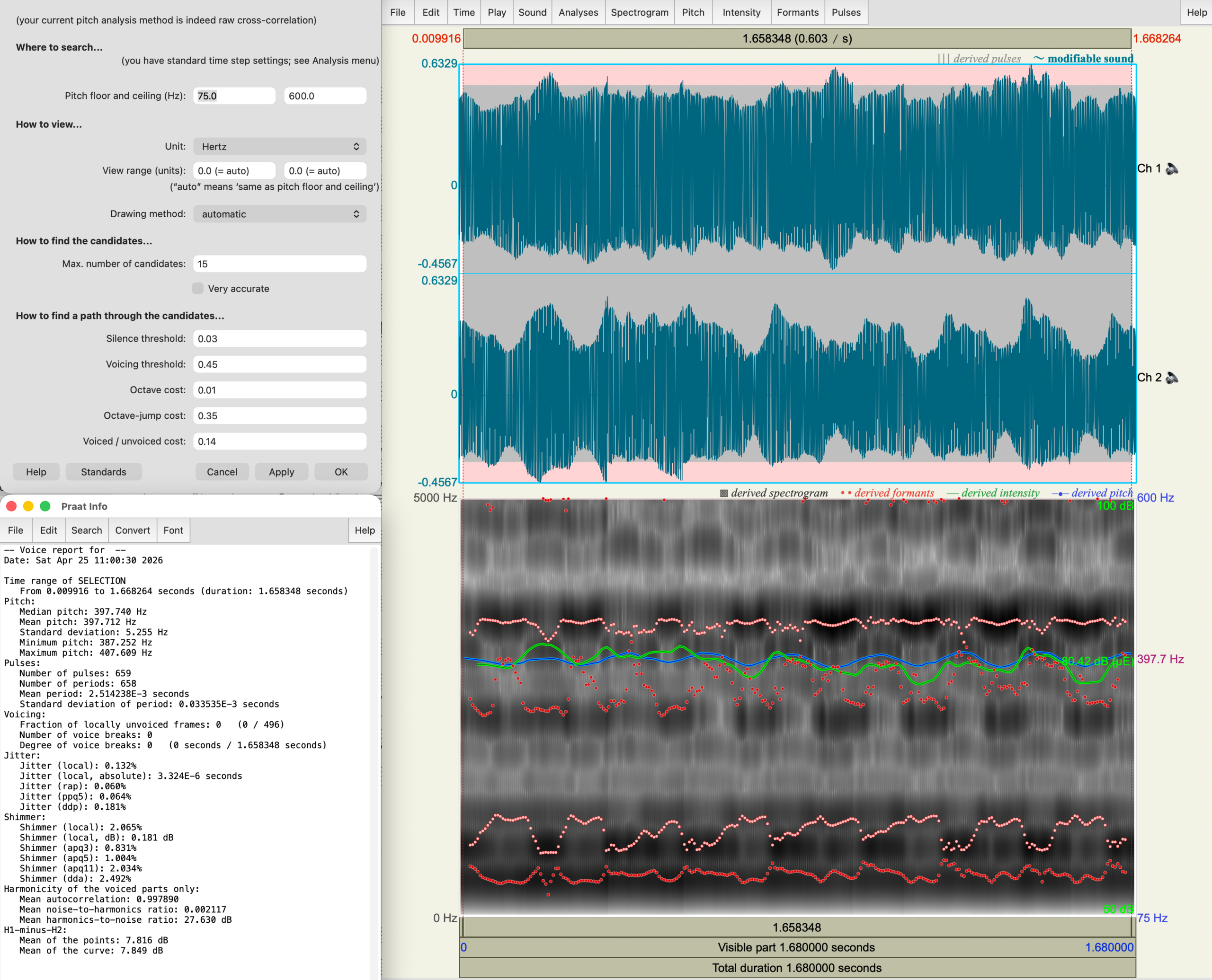
G 4, vowel “A” — pianissimo. Spectral analysis.
Acoustic Attestation: High-Register Dynamic Control
Subject: Spectral Analysis of High-Passage Pianissimo (G4 / 397.7 Hz). Vocal Profile: 51-year-old Operatic Bass.
1. Exceptional Harmonicity at Low Intensity
The analysis shows a Harmonics-to-Noise Ratio (HNR) of 27.638 dB.
- Significance: Achieving nearly 28 dB in pianissimo on a high G4 is remarkable for a Bass. It confirms that even when the breath pressure is reduced, the vocal fold approximation remains surgically clean, with zero “breathiness” or air leakage.
2. Micro-Stability and Vibrato Integration
The waveform and the Pitch graph show a very healthy, consistent oscillation:
- Jitter (local): 0.132% – Even in a delicate dynamic, the frequency remains rock-solid.
- Shimmer (local): 2.065% – Amplitude stability is excellent, showing a controlled and steady airflow without the typical “shaking” often found in untrained soft singing.
3. Spectral Balance (H1-H2 Relationship)
The H1-minus-H2 value of +7.8 dB indicates a clear dominance of the first harmonic (fundamental).
- Acoustic Impact: This is the textbook definition of a “flutey,” pure head-voice resonance. By allowing H1 to lead, the singer achieves a carrying, bell-like quality that can float over an orchestra even at the softest dynamic level.
Conclusion:
This G4 pianissimo is a testament to the Singing Lightly philosophy. It demonstrates that high-register singing for a Bass does not require “clutching” or “pressing.” Instead, it relies on acoustic balance and glottal efficiency. This is elite-level vocal architecture.
Analyzed by: Ondrej Mráz – Vocal Architect
Method: Singing Lightly