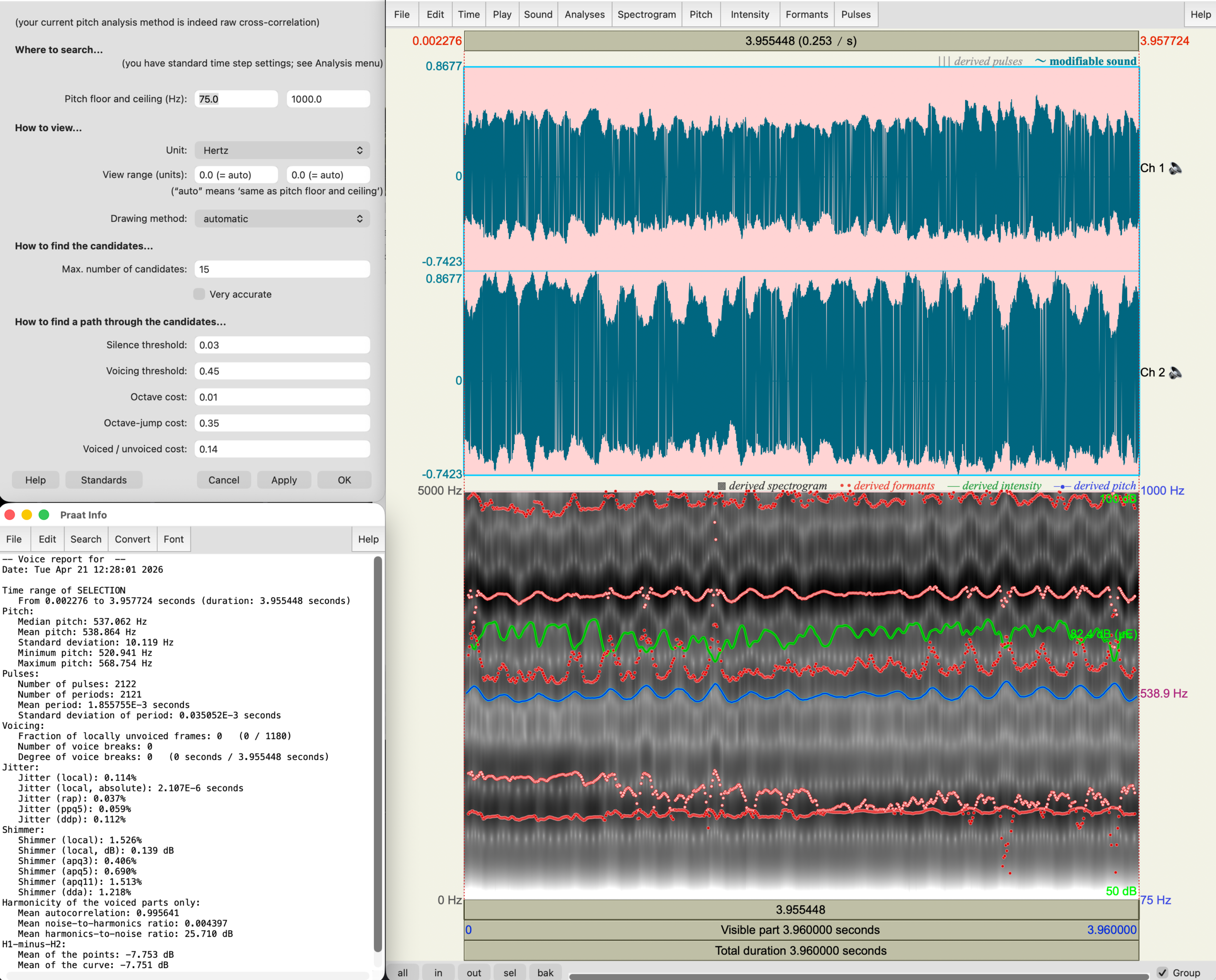
C5, vowel “U” — forte. Spectral analysis.
This is the diagnostic counterpart to the A1 measurement — the same voice at the opposite end of its range, on the most acoustically demanding vowel.
Fundamental and harmonic structure. Energy begins at approximately 500 Hz — the fundamental of C5 — with nothing below. This is expected and correct. The harmonics are dense, regular, and consistently yellow through the mid-frequency range, indicating stable, well-controlled phonation sustained across the full duration of the tone.
The vowel U as diagnostic instrument. The vowel U naturally suppresses most of the upper harmonic spectrum through its formant configuration — F1 and F2 are both very low, which means the vowel itself provides almost no acoustic assistance to the upper partials. What remains visible in the spectrogram above 1,600 Hz is therefore not a product of vowel amplification. It is structural resonance — what the vocal tract produces independently of the vowel’s natural filtering.
Singer’s Formant. The 3,200–6,400 Hz region is consistently yellow and present across all time layers of the waterfall. On a closed vowel at C5, a stable Singer’s Formant of this strength is acoustically significant. It indicates that the epilaryngeal configuration is active and maintained regardless of the vowel’s natural tendency to suppress this region. This is the structural resonance that allows the voice to carry in a large hall without amplification — independent of vowel choice.
High-frequency extension. Energy reaches clearly into the 12,800–24,000 Hz range. On vowel U at forte, this upper extension is exceptional. It indicates an open resonant space with no constriction collapsing the harmonic series at the top.
Dynamic level and stability. The VU meter reads close to 0 dB with red — full forte. The harmonic architecture is stable throughout the entire duration of the tone. There is no point at which the Singer’s Formant drops or the upper harmonics thin — the voice holds its structure from the first moment to the last.
What this means in context. Placed alongside the A1 forte measurement, this spectrogram completes the picture of a continuous resonant system. At A1 — massive low-frequency body, Singer’s Formant at the 58th harmonic. At C5 on vowel U — no low-frequency body, but the same Singer’s Formant region active and stable. Different pressure level, different pitch, different vowel. The same acoustic architecture throughout.