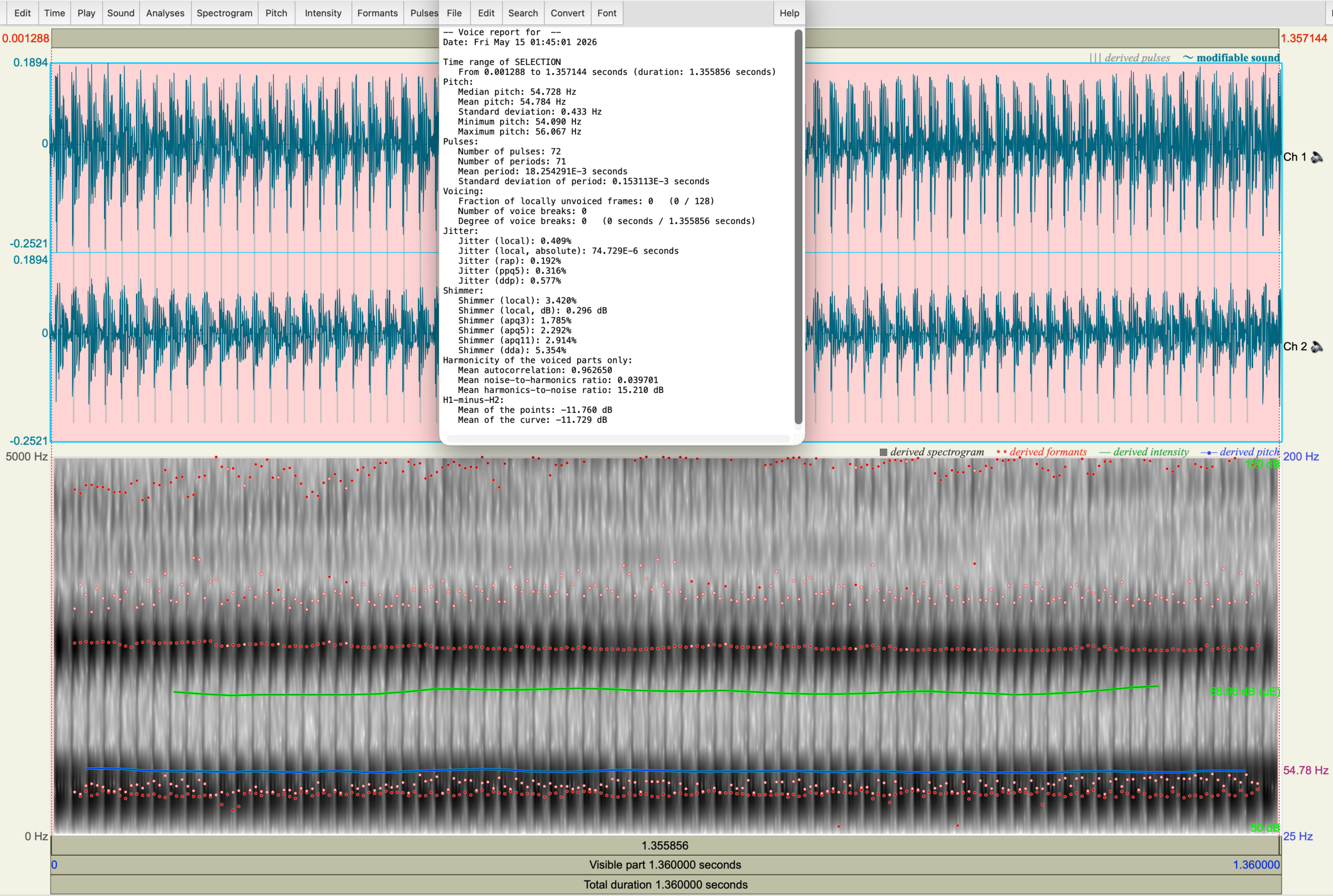
A1, vowel “A” — forte. Spectral analysis.
Mid-Fundamental and low-frequency body. Energy begins immediately at the left edge of the graph — from 20 Hz — and builds continuously through the low-frequency region. The broad, dense wave formations between 20 and 400 Hz are characteristic of a genuinely deep bass fundamental. The harmonics of A1 are spaced only 55 Hz apart, meaning they merge into wide formant bands rather than appearing as individually resolved peaks. What appears here as undulating mass is the cumulative acoustic energy of dozens of harmonics packed into each frequency band.
Mid-frequency structure. The 400–1,600 Hz region shows strong, consistent energy — the harmonic series carrying the body and colour of the tone. The wave crests running through this area are stable and regular, indicating clean, controlled phonation at full dynamic.
Singer’s Formant. The 3,200 Hz region — the Singer’s Formant window — is present and measurable. At A1, this corresponds to approximately the 58th harmonic. For this band to carry measurable energy at this fundamental frequency, the vocal tract must be actively amplifying harmonics at this level of the series. In published acoustic research on bass voices, a measurable Singer’s Formant below C2 is considered a marker of exceptional vocal development.
High-frequency extension. Energy continues through the 6,400–12,800 Hz range and beyond. On a vowel “A” at forte, this upper extension indicates an open resonant space with no constriction collapsing the harmonic series.