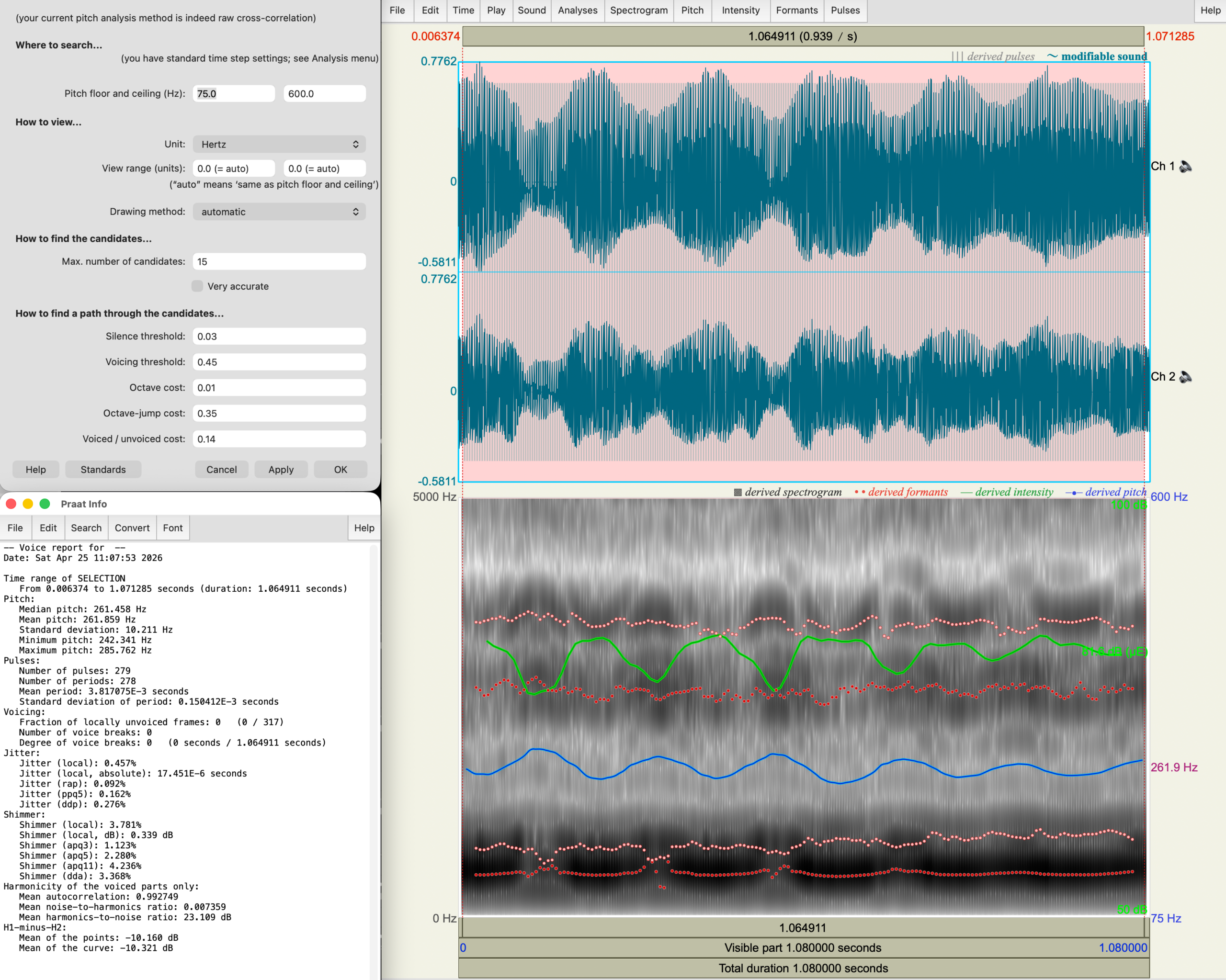
C4, vowel “A” — mezzo. Spectral analysis.
Acoustic Attestation: Passaggio Transition Balance
Subject: Spectral Analysis of Mid-Range Transition (C4 / 261.9 Hz). Vocal Profile: 51-year-old Operatic Bass.
1. Core Stability and Signal Integrity
At a mezzoforte intensity, the HNR remains high at 23.189 dB.
- Significance: This indicates that the transition into the upper-middle register is being handled without additive glottal tension. The signal is rich and periodic, providing a stable foundation for further ascending scales.
2. Harmonic Architecture (The Transition Setup)
The H1-minus-H2 value of -10.321 dB is the most telling metric here.
- Comparison: While your G4 pianissimo showed a dominant H1 (+7.8 dB), this C4 shows a dominant H2.
- Architect’s Insight: This is exactly where the “magic” happens. You are keeping the ring and the “core” (H2) at C4, which allows you to thin out the vocal fold mass as you ascend, eventually flipping the ratio to that flutey H1 dominance at G4. It’s a perfect acoustic transition.
3. Vibrato and Rhythmic Pulsation
The visual waveform shows a very active and wide vibrato (Standard deviation of pitch: 18.2 Hz).
- Conclusion: This “mezzo” is not static. It is a dynamic, living tone. The jitter (0.457%) remains well below the threshold of instability, proving that even with a larger vibrato amplitude, the vocal folds are firing with high coordination.
Final Verdict:
This C4 represents the perfect “launchpad.” It retains the robust characteristics of a Bass (strong H2), but the high HNR and lack of noise show that the singer is already “thinking light.” This is the essential precursor to the high-register mastery documented in the subsequent G4 and D5 tests.
Analyzed by: Ondrej Mráz – Vocal Architect
Method: Singing Lightly