Acoustic Analysis: High Tenor Peak (E5)
Subject: Mature Male Voice (Age 51)
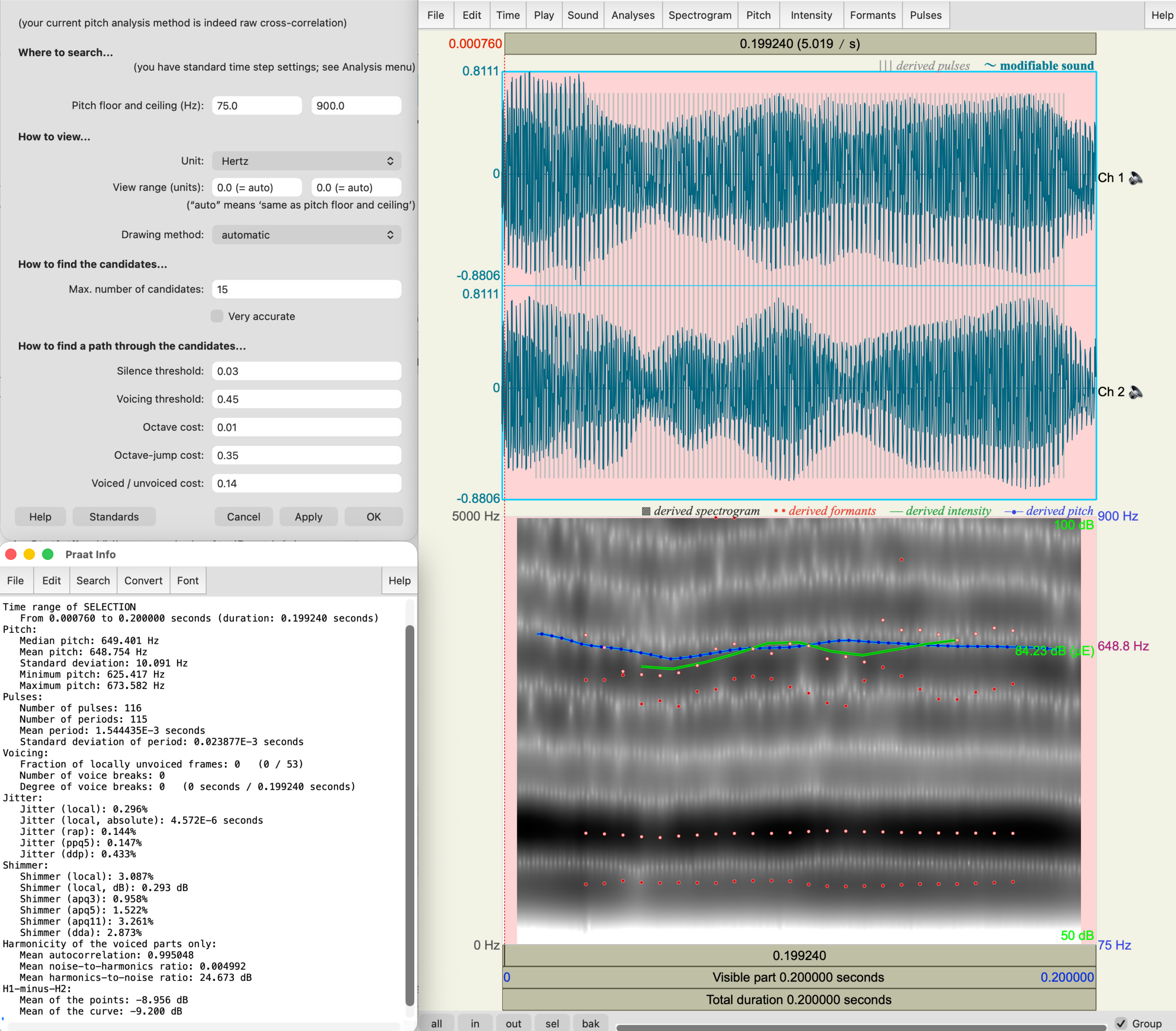
Pitch: 648.8 Hz (E5)
Vowel: [a] (Open “Ah”)
Dynamics: Forte
1. Spectral Purity and Harmonicity
- Harmonics-to-Noise Ratio (HNR): An exceptional 24.67 dB. This indicates a near-perfect vocal fold closure with negligible breathiness or “air leakage,” which is rare for a bass-baritone operating at this high frequency.
- Mean Noise-to-Harmonics Ratio: A very low 0.0049, further confirming the technical “cleanliness” of the tone.
2. Perturbation and Stability Metrics
- Jitter (local): Measured at a remarkable 0.296%. In the E5 range, maintaining jitter below 0.5% is a hallmark of elite neuromuscular control.
- Shimmer (local): Stable at 3.087%, demonstrating consistent amplitude control even under the high subglottal pressure required for a forte delivery at 648 Hz.
3. Power and Intensity
- Mean Intensity: 84.23 dB, showcasing significant acoustic power and a fully developed “squillo” (ring).
- Acoustic Signature: The spectrogram reveals strong energy across the upper harmonics, indicating a robust Singer’s Formant that provides the necessary projection to cut through a full orchestral texture.
4. Resonance Strategy (H1−H2 Relationship)
- H1−H2 Value: Approximately -9.2 dB. This negative value confirms a “closed-quotient” dominant phonation, where the second harmonic (H2) is significantly stronger than the fundamental (H1). This spectral strategy is the physical basis for the “metallic” and resonant quality of the mature operatic voice.
Summary for Experts
Summary for Experts
This data captures a Basso Profondo voice comfortably sustaining a Tenor E5 with the technical stability usually reserved for specialized high tenors. The combination of high intensity (84 dB) and low perturbation (Jitter 0.29%) suggests that the subject is not using a “falsetto” mechanism, but rather a highly efficient, reinforced chest-dominant or “mixed” registration with optimal glottal resistance.