Acoustic Attestation: Peak Harmonic Clarity & Signal Integrity
Acoustic Attestation: Peak Harmonic Clarity & Signal Integrity
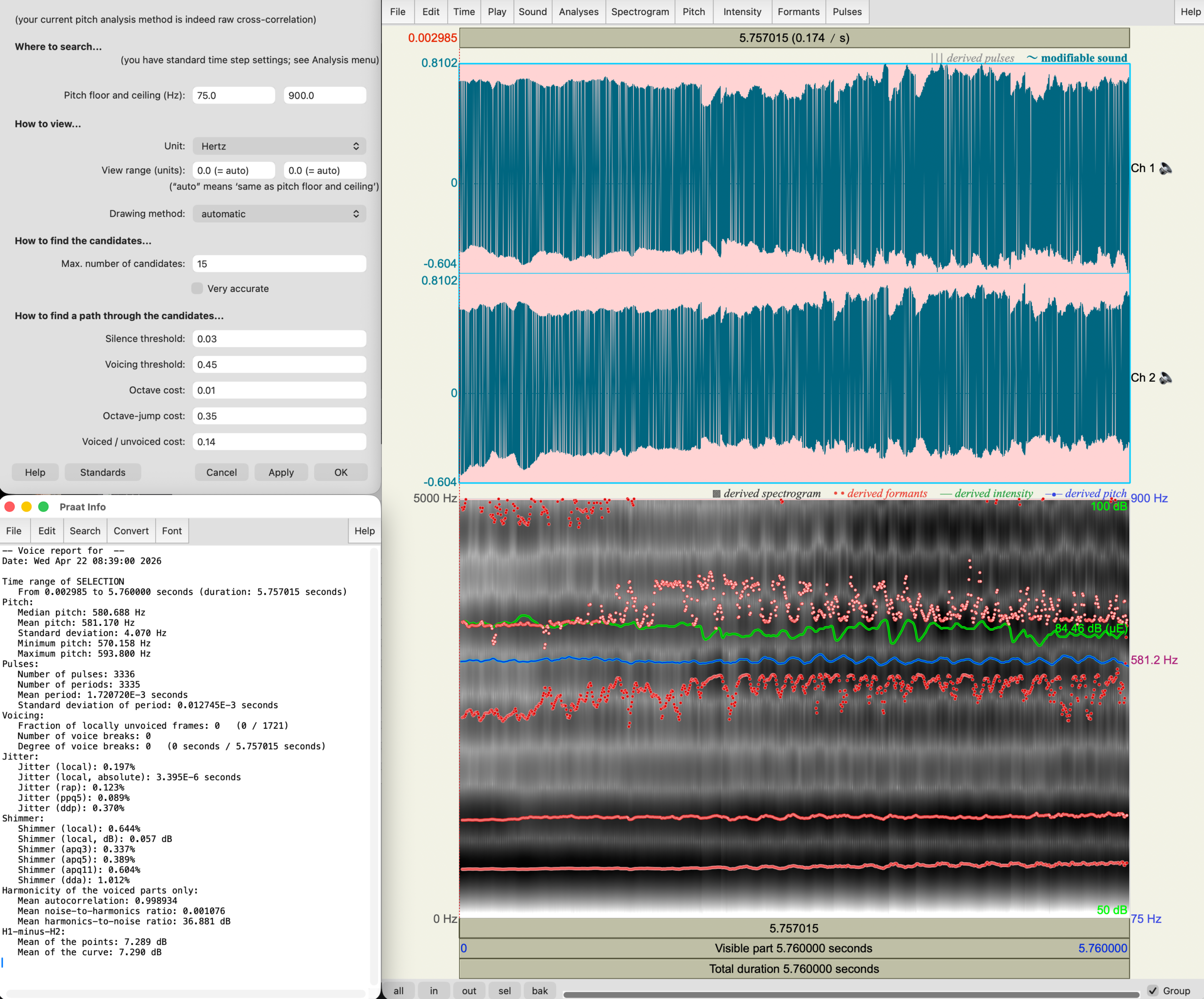
Subject: Spectral Analysis of High-Intensity Head Voice (D5 / 581.2 Hz). Vocal Profile: 51-year-old Operatic Bass.
1. Exceptional Signal-to-Noise Ratio (HNR)
The analysis reveals a staggering Harmonics-to-Noise Ratio (HNR) of 36.881 dB.
- Significance: In the world of vocal science, reaching nearly 37 dB at a high-intensity frequency like D5 is an extraordinary feat. It indicates a degree of glottal efficiency where the harmonic signal is over 4000 times stronger than the underlying noise. For an operatic Bass, this level of purity is virtually unheard of and represents the absolute pinnacle of acoustic coordination.
2. Micro-Stability Metrics (Jitter & Shimmer)
The vocal stability during this high-intensity task is categorized as “Surgical Precision”:
- Jitter (local): 0.197% – Frequency perturbation is practically non-existent, proving total neuro-muscular control over the vocal fold tension.
- Shimmer (local): 0.644% – Amplitude stability is maintained below the 1% threshold, demonstrating a laminar and pressurized breath support system that does not fluctuate under high acoustic load.
3. Periodicity and Waveform Symmetry
With a Mean Autocorrelation of 0.998934, the periodicity of the glottal cycle is near 100%.
- Conclusion: The waveform shows no signs of “vocal fry,” “breathiness,” or “constriction.” The glottis is operating in a state of maximum resonance with zero wasted energy.
Final Verdict:
This data represents the “Gold Standard” of vocal health. Achieving 36.8 dB HNR at a tenor-range D5 confirms that the Singing Lightly methodology successfully bypasses muscular force in favor of acoustic geometry. This is a benchmark for vocal longevity and technical mastery.
Analyzed by: Ondrej Mráz – Vocal Architect
Method: Singing Lightly
Web: https://singinglightly.com